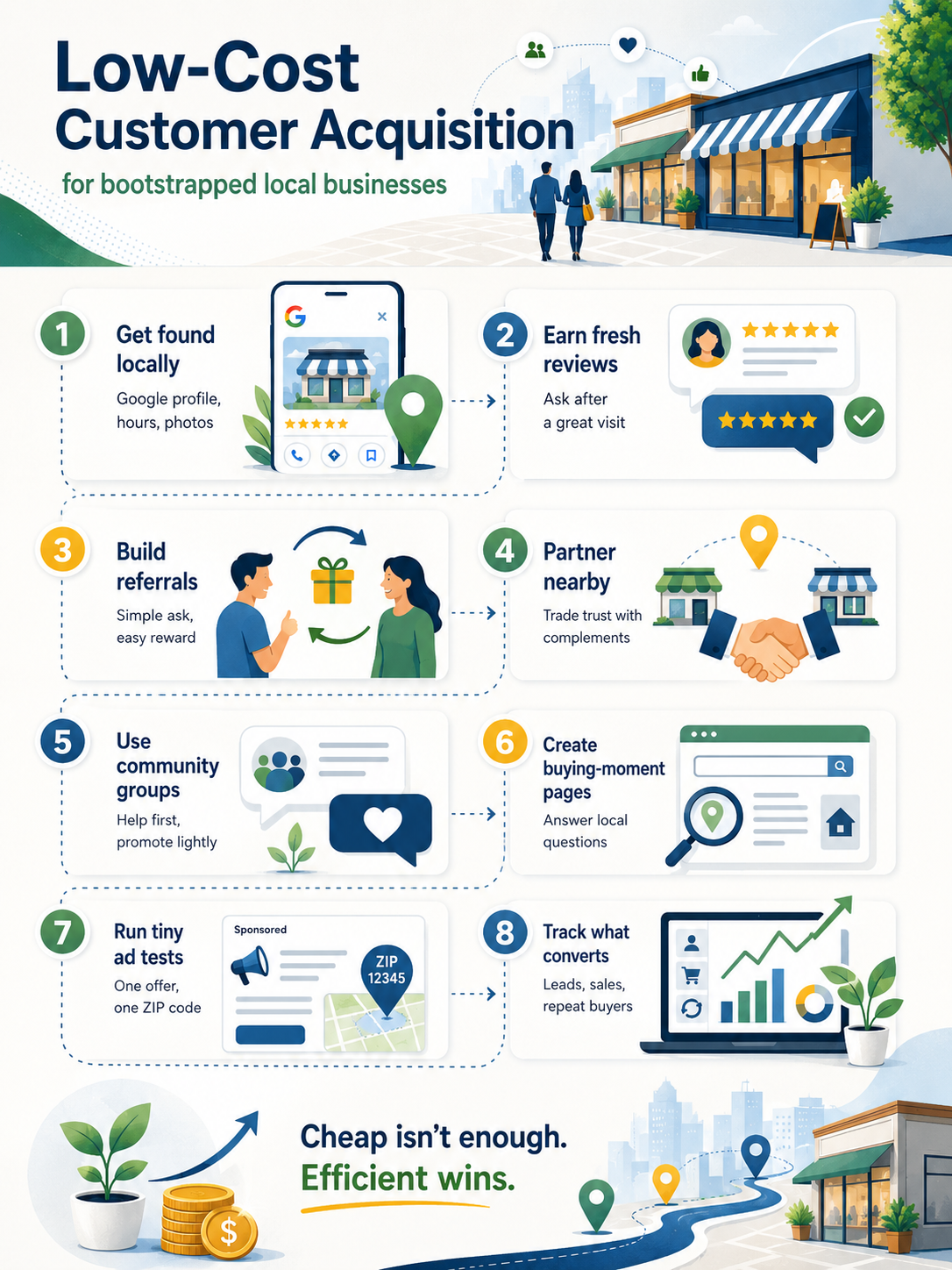

A bootstrapped local business rarely has a marketing problem in the abstract. It has a Tuesday problem: three empty appointment slots, a slow lunch rush, a quiet inbox, a rent check due soon, and no patience for advice that starts with “build a funnel.”
The best low-cost customer acquisition tactics do not feel glamorous. They tighten the path between a nearby person with a real need and a business that can solve it. They make the business easier to find, easier to trust, easier to contact, and easier to recommend. That sounds simple because it is. The hard part is doing it every week without getting distracted by whatever platform is loudest that month.
Start by defining cheap correctly
Low-cost customer acquisition does not mean free. A tactic can cost $0 and still waste a founder’s time, attention, and credibility. Posting in twenty Facebook groups every morning might look cheap until it trains local residents to ignore the business. Discounting heavily might bring in new buyers while quietly teaching them never to pay full price.
For a bootstrapped owner, acquisition cost has four parts:
- Cash spent on ads, printing, sponsorships, software, discounts, or events.
- Time spent creating, posting, replying, following up, and selling.
- Margin given away through promotions or referral rewards.
- Quality of customers acquired.
That fourth part gets missed. A customer who buys once at a deep discount, complains for an hour, and never returns was not cheap. A customer who found the business through a neighbor, paid the standard rate, left a review, and came back three months later was.
The practical goal is not “get customers for free.” It is to build a small acquisition system where the next customer costs less to win than the last one.
Shrink the target market
Most local businesses define their audience too broadly because they are afraid of excluding revenue. A new cleaning company says it serves “homeowners in Phoenix.” A better target might be “two-income households within eight miles of Arcadia that need recurring maintenance cleaning, not one-time move-outs.” That narrower version makes every acquisition tactic sharper.
The U.S. Small Business Administration recommends using market research to understand demand, market size, customer location, pricing, and market saturation before trying to reach buyers. For local businesses, that research can be practical and small: look at the neighborhoods you can serve profitably, the competitors already there, the customers who buy fastest, and the jobs they hire you to do. The point is not a polished research deck. It is a cleaner acquisition bet. SBA
| Loose audience | Better acquisition angle | Why it works |
|---|---|---|
| “Everyone who needs a haircut” | Men within three miles who need a reliable cut before work | The offer, hours, photos, and local search terms become specific. |
| “Small businesses” | Local medical offices that need same-week print materials | The business can build a referral list and outreach script. |
| “People who like fitness” | New parents who need 30-minute strength classes near daycare pickup | The schedule and message match a real constraint. |
| “Homeowners” | First-time homeowners with older HVAC systems in two ZIP codes | The content, mailers, and partner referrals become easier to aim. |
A narrow target market does not prevent other people from buying. It gives your marketing a spine.
Fix the local search path first
Before spending money to get more attention, make sure existing demand can find and trust you. Many local businesses leak customers at the most basic points: wrong hours, weak photos, no service list, no booking link, a dead contact form, or a website that explains the owner’s story but not what the customer should do next.
Start with Google Business Profile because it is free for eligible storefront and service-area businesses, and Google says it lets businesses manage how they appear on Search and Maps at no charge. A verified profile can include hours, location or service area, phone number, website, photos, videos, reviews, booking links, and updates. Google
This is not “SEO” in the vague agency sense. It is the modern storefront window.
A basic local search cleanup should cover:
- The exact business name, address, phone number, website, and hours.
- Primary and secondary categories that match what customers search for.
- A short service list written in customer language, not internal jargon.
- Recent photos of the exterior, interior, team, work, menu, products, vehicles, or results.
- A direct call button, booking link, quote form, or message option.
- A review request process that happens after every successful job or visit.
BrightLocal’s 2026 Local Consumer Review Survey found that 97% of consumers read reviews for local businesses, and 74% care about reviews written in the last three months. One old five-star review is not enough. Local trust decays. BrightLocal
The low-cost move is to create a weekly review habit. Do not wait until the business “needs more reviews.” Ask when the customer is happiest: after the repaired sink works, after the dog looks clean, after the first class feels less intimidating, after the catering order lands on time.
A simple request works better than a dramatic one:
“Thanks again for coming in today. Reviews help local customers decide who to trust. If you have a minute, would you be willing to leave a quick note about your experience?”
Then send the direct review link. No guilt. No essay request. No pressure for a positive rating.
Build a proof stack
A stranger does not trust a local business because the business claims to be friendly, affordable, experienced, or reliable. Those are table stakes. The stranger trusts patterns.
A proof stack gives them those patterns before they call:
- Photos that show the real place, people, work, or product.
- Reviews that mention specific outcomes.
- A clear service area.
- Transparent starting prices, package examples, or “best for” descriptions when possible.
- Fast replies to public questions and reviews.
- A website page that answers the questions customers ask on the phone every day.
Think of a mobile detailing business. “Premium auto detailing” says almost nothing. A proof stack says: before-and-after photos of a work truck, a ceramic coating FAQ, three reviews from local SUV owners, a page for fleet washes, a starting price for interior details, and a note that the business serves Chandler, Gilbert, and Ahwatukee on specific days.
That kind of specificity lowers the customer’s risk. It also lowers your sales burden because fewer people call with mismatched expectations.
Turn customers into referrers
Referral programs fail when they sound like a corporate growth hack pasted onto a neighborhood business. “Give $20, get $20” can work, but only if the experience is good enough that customers would mention the business anyway.
A better starting point is a referral habit, not a program.
Ask three questions after a strong customer interaction:
- Who else has this same problem?
- What would make it easy for this customer to introduce us?
- What is a fair thank-you that does not cheapen the service?
For a local accountant, the answer might be a short email the client can forward to another business owner. For a personal trainer, it might be a free guest pass for a friend. For a dog groomer, it might be a small add-on service after a referred customer books. For a B2B printer, it might be priority turnaround on the next order.
The ask should be plain:
“If you know another office manager who gets stuck ordering print materials at the last minute, feel free to send them my way. I’ll take good care of them.”
Some businesses should formalize the offer. Others should keep it relationship-based. The test is whether the customer can explain it in one sentence.
Be careful with reviews and incentives. The Federal Trade Commission says businesses should not ask only happy customers for reviews, should not ask people who have not used the product or service, and should not ask staff, family, or friends for undisclosed reviews. The FTC’s rule also targets fake reviews and misleading testimonials. FTC
That does not mean you can never thank customers. It means you should not buy praise, hide relationships, or tie a reward to a positive review.
Borrow local trust
A bootstrapped business cannot buy instant trust, but it can stand near people and organizations that already have it. The trick is to choose partners with overlapping customers and noncompeting offers.
Good local partnership pairs are obvious once you look for the customer’s next problem:
- A pediatric dentist and a children’s haircut studio.
- A real estate agent and a home inspector.
- A yoga studio and a physical therapist.
- A coffee shop and a neighborhood bookstore.
- A wedding photographer and a florist.
- A boutique hotel and a local tour guide.
- A CPA and a payroll consultant.
The lowest-cost version is not a big co-branded campaign. It is a useful exchange.
A home organizer could give a moving company a one-page “first weekend unpacking checklist” with her name and QR code at the bottom. The moving company gives customers something helpful; the organizer reaches people at the moment they need help. A mechanic could create a “used car test-drive checklist” for a local credit union. A bakery could supply small samples for a nearby bridal boutique’s appointment days.
The rule: make the partner look good. If the partnership only asks them to promote you, it will die quietly.
Use community channels carefully
Community platforms can bring in local customers quickly, but they punish clumsy promotion. Neighborhood Facebook groups, Nextdoor, local subreddits, parent groups, school fundraisers, chamber forums, and community newsletters all have their own norms. Treat them like rooms, not billboards.
Nextdoor lets local businesses claim a free Business Page, publish free posts, collect recommendations, and share updates with nearby customers. Nextdoor
That does not mean every post should sell. A local business earns attention by being useful before asking for money.
Better community posts look like this:
- A plumber posts a freeze-prep checklist before a cold snap.
- A café shares which local streets are closed during a weekend event.
- A pet sitter explains what to ask before hiring holiday care.
- A landscaper posts a monthly watering reminder for local conditions.
- A children’s boutique shares a sizing guide before school starts.
These posts work because they match the customer’s life, not the owner’s desire to promote.
When a group allows business promotion only on certain days, follow the rule. When someone asks for recommendations, answer directly and disclose your connection if you are the owner. When a thread is emotional or political, stay out. Reputation is an acquisition asset, and local audiences remember bad judgment longer than a clever offer.
Capture offline attention
Local businesses still win customers offline. The mistake is treating offline marketing as untrackable. A flyer, sign, receipt, event booth, bag insert, or handout can point to a specific next step.
A good offline acquisition asset has three parts:
- A reason to care now.
- A simple action.
- A way to track the source.
A restaurant should not print “Visit us soon” on a postcard. It should print “Bring this in before 5 p.m. for the neighborhood early dinner menu” with a short code the cashier can enter. A med spa should not sponsor a charity run with only a logo on the banner. It should bring a QR code for a skin consultation waitlist and a small sign explaining who it is for. A tutoring center should not hand parents a brochure packed with credentials. It should offer a free “math confidence check” for students entering algebra.
Offline tactics worth testing:
- Counter cards at complementary businesses.
- Receipt inserts for repeat purchase offers.
- Door hangers in tightly selected streets after completing nearby work.
- Yard signs at job sites, with customer permission.
- Local event checklists or maps branded by the business.
- QR codes that lead to a dedicated landing page, not the homepage.
- Printed cards that ask satisfied customers to review, refer, or book again.
Do not flood a whole city. Pick one building, block, school community, subdivision, or office park. Local acquisition gets cheaper when density rises. Ten customers in one neighborhood are more useful than ten customers scattered across a metro area.
Build an email list you can actually use
Email is not mainly a new-customer channel for most local businesses. It is a repeat-purchase, referral, and reactivation channel. That still matters for acquisition because retained customers reduce the pressure to replace everyone with strangers.
The list can start small:
- A salon collects emails for cancellation openings and seasonal service reminders.
- A restaurant collects emails for private event menus and neighborhood specials.
- A contractor collects emails for maintenance reminders.
- A fitness studio collects emails for beginner workshops.
- A boutique collects emails for new arrivals in specific sizes or categories.
The first mistake is offering “updates.” Nobody wants updates. Offer something concrete: appointment openings, seasonal reminders, neighborhood-only menus, class schedules, restock alerts, care tips, or first access to limited spots.
The second mistake is sending only promotions. A local HVAC company can send a pre-summer filter reminder. A bike shop can send a “what to check before your first spring ride” note. A CPA can send quarterly tax deadline reminders for local freelancers.
Commercial email has rules. The FTC’s CAN-SPAM guide says commercial messages need accurate header information, non-deceptive subject lines, a valid physical postal address, and a clear way to opt out. FTC
A small list of people who asked to hear from you beats a large list scraped from local websites.
Create content for buying moments
Most local content fails because it copies national blog topics. A local roofing company does not need a generic post titled “Why roofs matter.” It needs pages and posts that match local buying moments:
- “What to do after hail damages your roof in [city].”
- “How much does a small bathroom remodel cost in [neighborhood]?”
- “Best time to prune citrus trees in [region].”
- “Same-day catering for office lunches near [business district].”
- “Beginner Pilates classes near [landmark].”
The format does not have to be long. A useful page can answer five questions better than competitors answer fifty. Price ranges, timelines, service boundaries, parking instructions, preparation checklists, before-and-after photos, and “not a fit if…” notes all help customers decide.
A strong local page usually includes:
- The service or product in plain language.
- The area served.
- Who the offer is best for.
- Starting price or pricing factors, if possible.
- Proof from nearby customers.
- Photos from real work.
- A clear next step.
The “not a fit” section can be surprisingly effective. A house cleaner might say, “We are not the cheapest option for one-time post-construction cleaning. We are a better fit for recurring maintenance cleaning and move-in refreshes.” That sentence saves sales time and attracts better-fit customers.
Run tiny paid tests
Paid ads are not the enemy of bootstrapping. Unfocused ads are. A $75 test can teach a local business something useful if the offer, audience, and follow-up are tight. A $750 campaign can teach nothing if it sends vague traffic to a weak homepage.
Before buying reach, check the conversion path:
- Does the ad match a real local need?
- Does the landing page continue the same promise?
- Can the customer call, book, ask a question, or claim the offer in one click?
- Will someone reply quickly?
- Is the offer profitable if ten people take it?
- Is there a way to know which customers came from the ad?
Tiny tests work best for specific goals: fill five weekday lunch tables, book six spring tune-ups, sell out a workshop, generate ten quotes in one ZIP code, or revive slow appointment slots.
Avoid broad awareness campaigns until the business has money to waste. Most bootstrapped businesses need action, not impressions.
A reasonable test structure:
| Test element | Low-cost version | Stop rule |
| Audience | One ZIP code, neighborhood, or radius | Stop if clicks come from outside the profitable service area. |
| Offer | One service, event, menu, or appointment type | Stop if inquiries ask for something else. |
| Budget | Small fixed spend over 5 to 10 days | Stop if cost per qualified lead exceeds margin tolerance. |
| Landing page | One page or booking link tied to the offer | Stop if visitors click but do not call, book, or submit. |
| Follow-up | Same-day reply script | Stop if the team cannot respond fast enough. |
Paid ads should amplify what already converts. They should not compensate for a confusing offer.
Measure the few numbers that matter
A bootstrapped owner does not need a complicated dashboard. The best acquisition tracking system may be a spreadsheet, a notebook by the register, or a required field in the booking form: “How did you hear about us?”
Track four numbers by channel:
- Leads or first-time visits.
- Qualified leads or good-fit first-time visits.
- New customers.
- Revenue or gross profit from those customers.
Then add one judgment call: would you want more customers like this?
That question protects the business from deceptive metrics. A coupon site might drive a spike in first-time visits and still be a bad channel. A referral from a local realtor might send only two customers in a month and still be excellent because both are profitable and easy to serve.
Set a weekly acquisition rhythm:
- Monday: check reviews, messages, missed calls, and booking form issues.
- Tuesday: ask recent happy customers for reviews or referrals.
- Wednesday: publish one useful local post, email, or short video.
- Thursday: contact one potential partner or past customer.
- Friday: review channel results and decide what to repeat, stop, or adjust.
This routine is deliberately small. A local business with limited cash usually wins through repetition, not a massive campaign.
Match tactics to business type
The right low-cost tactic depends on how customers buy. A walk-in café, a plumber, and a local B2B bookkeeper should not use the same acquisition playbook.
| Business type | Best low-cost acquisition bets | What to avoid |
| Restaurants and cafés | Google profile photos, review requests, local event tie-ins, receipt offers, neighborhood email list | Constant discounting that trains regulars to wait for deals |
| Home services | Door hangers near completed jobs, review generation, neighborhood pages, realtor partnerships, maintenance reminders | Buying leads in too wide a service area |
| Salons and personal care | Rebooking prompts, referral cards, cancellation list, before-and-after photos, local influencer visits with disclosure | Posting only finished looks without prices, availability, or booking instructions |
| Fitness and wellness | Beginner workshops, referral passes, local employer partnerships, email challenges, testimonial pages | Selling broad “get healthy” promises instead of specific programs |
| Local retail | New-arrival alerts, in-store events, cross-promotions, local gift guides, Google product photos | Competing with ecommerce on price alone |
| B2B local services | Niche outreach lists, chamber relationships, educational checklists, referral partners, LinkedIn posts aimed at local operators | Generic networking with no follow-up system |
The pattern is simple: choose tactics that fit the buying trigger. Emergency services need visibility and response speed. Relationship services need trust and referrals. Retail needs foot traffic, reasons to return, and timely inventory communication. B2B services need credibility and repeated contact.
Avoid cheap tactics that get expensive
Some tactics look affordable because the invoice is small. The real cost appears later.
Buying reviews is one. It risks platform penalties, legal trouble, and local embarrassment. It also gives the owner false confidence because fake praise does not reveal what customers actually experience.
Over-discounting is another. Discounts can introduce a business to new customers, but they should have a purpose: fill perishable capacity, promote a new service, reward a specific behavior, or create a first trial. A standing discount with no strategy becomes the real price.
Spraying generic posts across community groups also gets expensive. The business spends social trust for tiny reach. Local promotion works better when the owner answers real questions, shares useful timing, and posts offers only where they belong.
The last trap is chasing virality. A local business does not need a million views from people five states away. It needs enough trust from nearby customers to keep the calendar, tables, trucks, chairs, or inbox full.
Make acquisition compound
Low-cost customer acquisition is rarely one magic tactic. It is a set of small assets that make each other stronger.
A better Google profile helps people trust the referral they just received. A review request keeps the profile fresh. A partner checklist gives customers a reason to scan a QR code. A useful email brings past buyers back. A neighborhood page helps searchers find the right service. A tiny paid test works because the proof stack was already there.
That is the advantage bootstrapped local businesses have over bigger competitors. They can be specific. They can answer faster. They can remember customers. They can show up in the same neighborhood again and again until the business becomes the obvious choice.
The owner’s job is not to try every marketing tactic. It is to build the few acquisition habits that match how local customers already decide: search, proof, proximity, recommendation, timing, and trust.